
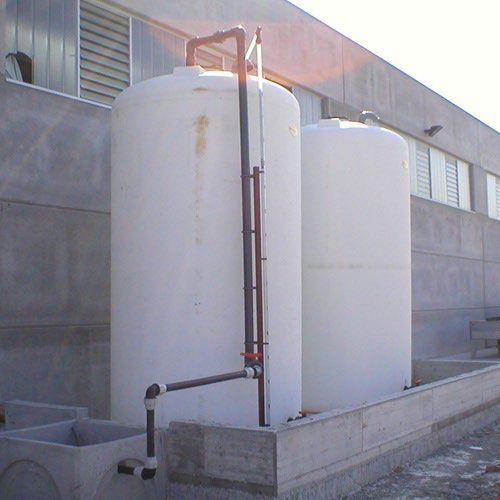
THERMOPLASTIC TANKS and SEISMIC RISK PREVENTION
It is clear that plastic tanks are not constructions in the most common sense of the term (i.e., manufactured in concrete and other building construction materials). However, when the intensity of the possible earthquake that hits the place where they are can generate danger for the safety of structures and people, they are considered either non-structural elements and / or systems. In this way they fall within the field of application of Technical Regulations for Constructions.
So designer must ascertain the size of the seismic risk, verify that each component, even if subjected to its forces, is able to safeguard the life and safety of men and things, submit the technical report to the control authorities and then make sure, during the execution phase that everything complies with the approved project.
The general legislation provides for exceptions: components of little importance are exempted from the assessment. The regional implementing rules specify the list. In principle, two competing limits are set for tanks: volume and height.
In Emilia Romagna tanks of less than 3m and 25mc are exempt, in Lombardy less than 3m and 15m, Piedmont less than 2m and 20m, Tuscany less than 2.5m and 30m (300 if irrigation use), Umbria less than 3m and 30m, Puglia less than 2.5mt and 15mc.
These limits are not absolute, in the sense that if the project concerns a site with a significant impact on public safety (e.g.: “Seveso” legislation) or areas with a high risk index (1 and 2) then it is still subject to checks by NTC.
Even if it seems questionable to include plastic tanks in the structural products to be certified, it must be considered that, if projects are subject to verification by public authorities, there is a margin of discretional interpretation by, both, the designer and the controller. Therefore, if they require a declaration of suitability for the tank to be placed in a seismic area, it is necessary to give them a convincing answer.
The way to answer depends on how the designer approaches the question. Broadly speaking, there are two cases:
- the reservoir is considered as an autonomous system, so it is required that in case of a seismic event, no damages are caused to structures and / or people.
From this point of view you have to calculate how the forces originating from the earthquake act on it, and verify under which conditions it is ensured that the positioning on the ground remains unchanged. - the tank is seen as a structure whose stress resistance at earthquake must be demonstrated, in regard its construction forms, contents and the materials.
Regarding this last case there are TWO possibilities:
A: certify the compliance of the tank with a harmonized Standard which includes, among the design parameters taken in account, also earthquake stresses
B: demonstrate, with ad hoc expertise, the actual resistance of the specimen to the forces induced by the earthquake in that place the earthquake act on it, and to verify under which conditions it is ensured that the positioning on the ground remains unchanged.
Depending on the type of construction, if the tank needs to be checked due to the size, location and intentions of the designer, these two cases give rise to different scenarios:
Extrusion (Helix) tanks:
- for the case sub 1 (fixing on ground) the typical conformation of these tanks is such as to allow a ground fixing with no problems, in almost all cases. After calculating the acting forces, you have only to shape how many standard anchors, usually supplied by the manufacturer, and how to implement them.
- for case sub 2 (structure strength) it should be remembered that the Standard generally adopted by all manufacturers, ie DVS 2205-2, although it represents the “rule of the art”, is not a harmonized European standard (EN). However, the same DVS 2205-2, at “supplement 4”, provides for a specific dimensional procedure in the event of a seismic zone that refers to 2 harmonized standards, EN 1998 (calculation of structures – silos, tanks and pipes – in seismic areas) and EN 1778 (characteristic parameters of welded thermoplastic structures).
Therefore, you can answer requests for seismic suitability by presenting the manufacturer’s declaration certifying compliance with the DVS 2205 standard, supplement 4 with the typical parameters of the place of installation.
If this is not possible, or because the manufacturer does not issue the aforementioned certification, or because it is not considered sufficient by the customer, then a specific verification report must be produced.
Rotomolded tank:
- for the case sub 1 (fixing on ground) there are problems descending from the structure of these products. The monolithic construction, together with the plastic deformations due to load and temperature, make a solid anchoring to the ground very difficult. The response to the request of resistance to oscillation, overturning or translation phenomena can then consist in setting up ground restraints (disconnected from the plastic body) which, due to their shape, size and materials, prevent unwanted movements induced by seismic shocks. For the determination of the constraints, a specific calculation report is drawn up.
- • for case sub 2 (structure strength) problems increase. There is no standard, even if not harmonized, for their construction that also includes earthquake stresses. Therefore, in the event of a request in this sense, the only way forward is a specific verification report. However, this presents some problematic aspects:
– this type of tanks is a serial production one, on a basis of repetitive procedures, so verification can only be carried on after their manufacture
– the monolithic structure has an almost uniform wall thickness, which can only be determined experimentally in a single point. The verification, on the other hand, must assess that in a whatsoever spot, which can be at the base, at the ridge or, for example, at the centre of gravity, there is sufficient material to counteract the boost of the liquid mass moved by gravity and earthquake. Assessment is therefore difficult, if only why in the three different positions, the same resistance resits different forces.
In summary, the following cases can occur for a plastic tank for which suitability for placement in a seismic area is required:
- the tank is or is not included in a site project context (because it replaces an existing one, because it is not connected to building works, because it is not required, etc.)
- the tank exceeds or does not exceed the dimensional limits provided for the exemption in that particular regional area
- if not exempt from verification, and Extrusion (helix) tanks, it may be necessary:
◦ certification of ground anchoring
◦ certification of the resistance structure compliance, issued under DVS 2205-2 supplement 4 OR specific structural verification report - if not exempt from verification, and rotomolded tank, it may be necessary:
◦ certification of ground anchoring
◦ certification of the structure resistance not possible (without prejudice to further investigation)